
Casinos That Accept Visa in the UK: Debit Cards
 Available in GB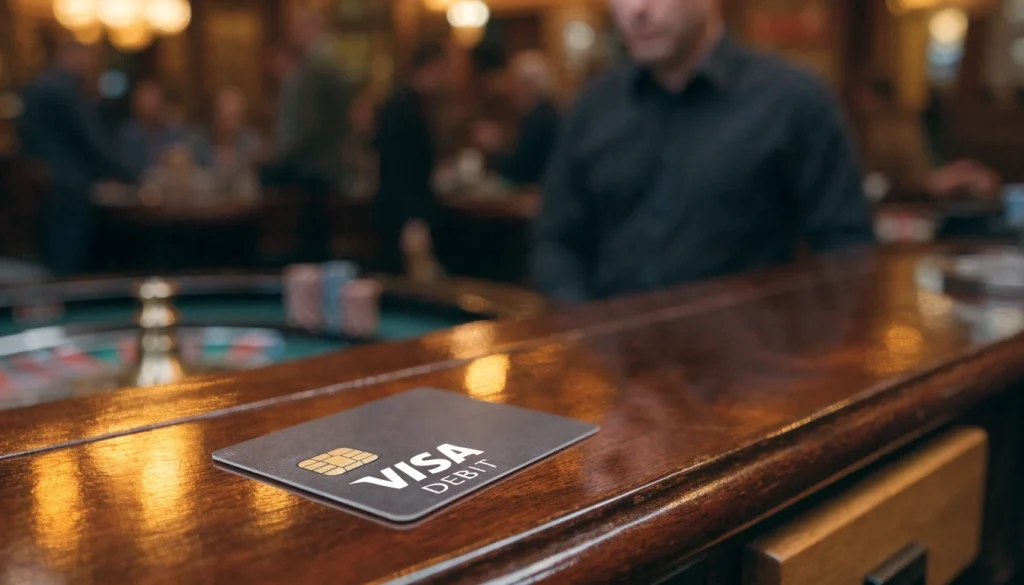
Visa debit and credit cards have different status at UK-licensed casinos, so the logo alone does not tell the whole story.
Visa in the UK casino cashier: what availability really means
Visa remains a familiar name in British casino cashiers, but the word “Visa” does not describe one single payment product. That distinction matters. A Visa debit card and a Visa credit card may carry the same logo, yet they do not have the same status when gambling is involved. For UK-licensed casinos, this is not a minor technical detail hidden in the small print. It is the line between an accepted card and a prohibited funding route.
UK casinos commonly accept debit cards, including Visa and Mastercard. This is why searches for casinos that accept Visa in the UK still produce a substantial number of results, and why Visa often appears alongside other payment methods in a casino’s banking section. A debit card can be connected directly to a current account, allowing a deposit to be taken from money already held there.
The position on credit cards is entirely different. The regulator introduced a ban on credit-card gambling on 14 April 2020, and that rule has not been relaxed. UK-licensed casinos cannot accept credit-card payments for gambling. The restriction also covers credit-card funding routed through a money service business. A Visa logo, therefore, is not enough to establish that a card can be used. The card’s actual product type is decisive.
Why the Visa logo is not the whole answer
Payment logos on a casino page are useful signposts, not a binding promise that every transaction will go through. A specialist affiliate review lists Visa and Mastercard among the methods associated with the casinos it examines. That kind of listing can show the payment brands being discussed, but it cannot establish that every casino currently supports every Visa product.
Payments at UK Casinos: Compare Deposit Methods · Casinos That Accept Instadebit in the UK
The live cashier has the more immediate say. It may identify the card category, reject a particular product, or show Visa only for accounts and transactions that meet the operator’s current payment conditions. Banking arrangements can change, and a payment method displayed in a general site description may not appear in the cashier at the point a deposit is attempted.
This is why “all Visa casinos UK” is a misleading idea if it suggests a permanent, universal catalogue. There is no single Visa status shared by every casino and every cardholder. One operator may display Visa debit while another may not offer it at that moment. Even where Visa is listed, the relevant question is whether the specific debit card is eligible for that casino’s current transaction process.
The same principle applies to descriptions such as “best Visa casinos” or “new Visa casinos”. A page may group casinos by the payment brands mentioned in their banking information, but the label does not turn Visa acceptance into a permanent feature. Nor does it establish that a casino offers a particular bonus, game selection or account facility because Visa appears in its payment list. Those are separate matters.
Debit and credit are not interchangeable
The British ban makes the debit-credit distinction unusually visible. A Visa debit card uses funds held in the associated bank account. A Visa credit card draws on borrowed funds, and UK-licensed casinos cannot use it for gambling payments. The shared Visa branding can make the two appear similar at a glance; the regulatory treatment makes them opposites.
Credit Card Ban
UK-licensed casinos are prohibited from accepting credit-card payments for gambling.
That difference also matters when a card is described casually as a “Visa deposit” method. The phrase may refer to Visa debit rather than to every card carrying the Visa name. A casino’s payment page can use a broad brand label while its operational controls apply a narrower eligibility test. The cashier, rather than the logo alone, determines whether the card can be used.
Age and account controls sit around this process as well. Remote gambling operators must verify a customer’s age before allowing a deposit into a gambling account. A payment card is therefore not a substitute for the casino’s account checks. The fact that a card is valid in shops or for ordinary online purchases does not mean it will be accepted for a gambling deposit.
What a sensible Visa check establishes
For a British casino account, Visa acceptance has three separate parts:
- the casino lists Visa as an available payment brand;
- the card is a debit product rather than a credit card;
- the current cashier accepts that card product for the account in question.
If one of those parts fails, the Visa logo does not rescue the transaction. This is particularly important for searches for UK casino sites accepting Visa deposits, because a broad payment label can look more definite than it really is.
The practical meaning of “Visa available” is therefore modest but useful: the casino may accept eligible Visa debit cards through its cashier. It does not mean that every Visa card will work, that every casino showing Visa is currently processing it, or that a credit card can be used under the same branding. A small logo carries a surprisingly large amount of administrative baggage.
Recommended online casinos
- ChanzeBonus: Slots Welcome Bonus #1 200% up to €500 · Payout speed: 1-3 business days
- AmunbetBonus: Join now and get 450% up to 2,700 GBP + 450 FS · Payout speed: 1-3 business days
- DieselwinBonus: Welcome Pack 250% up to £4000 + 200 FS · Payout speed: 1-3 business days
- SlotoSportBonus: 500% up to £ 10 200+ 777 FS · Payout speed: 1-3 business days
- ZombillionBonus: Welcome Pack 250% up to £4000 + 200 FS · Payout speed: 1-3 business days
- NightLuckBonus: Welcome Pack + 805% Up To 6400€ + 280 FS · Payout speed: 1-3 business days
- EvoSpinBonus: 125% up to €2500 + 125 Free Spins · Payout speed: 1-3 business days
- Revery PlayBonus: 100% up to€1,000+ 100 FS · Payout speed: 1-3 business days
- JetsetspinsBonus: 200% Bonus + 100 Free Spins + Free Royal Wheel · Payout speed: 1-3 business days
- x3betBonus: Welcome Pack 100% Up to £1.000 + 200 Free Spins · Payout speed: 1-3 business days
Depositing and cashing out: the route may not be the same
A Visa deposit and a Visa withdrawal are two stages of one payment journey, but they do not necessarily move at the same speed. A card deposit can appear in the casino account instantly, allowing play to begin without a visible waiting period. A payout is different: the casino must receive, review and approve the withdrawal before the money leaves its system. A specialist review describes this contrast as a card deposit arriving immediately while the corresponding payout takes several business days. That is a useful practical distinction, not a promise attached to every Visa cashier.
The delay is not necessarily caused by Visa. The casino’s internal approval process forms part of the withdrawal time, and the account’s verification status matters as well. The first withdrawal can take longer when KYC checks still need to be completed. Identity, age and payment ownership checks may be requested before funds are released. The process is less glamorous than the word “instant”, but gambling payments have always had a bureaucratic afterlife.
Casinos That Accept WebMoney in the UK: What to Check · Casinos That Accept AstroPay in the UK: What to Check
UK anti-money laundering controls generally point the payout back towards the payment source used for the deposit. Where a Visa debit card funded the account, the casino may therefore direct the withdrawal to that same card, subject to the operator’s cashier rules and the card’s eligibility. This is why a card that works for paying in should not automatically be treated as a guaranteed route for taking money out.
The cleanest arrangement is consistent ownership: the gambling account, the payment card and the bank details should belong to the same customer. Matching information reduces the chance that basic ownership questions interrupt a transaction. It also makes the explanation of where the money came from and where it is going considerably less complicated. A different person’s card, an account in another name or changing payment details mid-process can create avoidable friction.
This distinction also matters when the phrase “Visa casino” is used loosely. In Britain, credit-card payments for gambling are not permitted at UK-licensed casinos, so the relevant card route is a permitted Visa debit product rather than a Visa credit card. A deposit may therefore be accepted at the cashier while the withdrawal remains subject to verification, source-of-funds controls and the casino’s own processing stage.
A payout is consequently not simply a reversed deposit. It is a separate transaction with its own checks, timing and destination rules. The cashier may display a familiar card logo, yet the practical route is governed by the account record as much as by the card itself.
Withdrawal Timing
A card deposit may appear instantly, but a payout often takes several business days due to casino review and verification processes.
When Visa is not available: other ways to pay
Visa is familiar at British casino cashiers, but it is not the only route into an online gambling account. Payment menus are small maps of the financial habits around them: bank-led systems, digital wallets, prepaid money and the occasional service built for speed rather than ceremony. Their presence varies between operators, and the same name can mean something different in practice depending on the account and the cashier.
The alternatives therefore matter less as a fixed ranking than as a set of distinct payment arrangements.
PayPal and other digital wallets
PayPal is one of the better-known alternatives to a card deposit. Its appeal is easy to understand: the casino receives a payment through the wallet, while the customer does not have to enter card details into the casino account each time. A specialist affiliate review describes PayPal as popular for speed and convenience, although it also notes that a PayPal payment may be left outside a casino’s bonus eligibility. That small qualification is important. A payment method can be convenient without being treated like every other method in promotional terms.
Skrill and Neteller occupy a similar space. They are electronic wallets used at some UK-facing casino sites, giving account holders another way to move funds without paying directly by Visa. A specialist affiliate review reports that Skrill and Neteller are available at some sites and are often excluded from promotions. Skrill is also described in specialist affiliate coverage as one of the most common deposit methods at UK-friendly casino sites in 2026.
Casinos That Accept Solana in the UK: What Is Verified · Casinos That Accept Wirecard in the UK
That does not turn either wallet into a universal substitute. Availability belongs to the individual casino, not to the name printed on the wallet. A wallet may appear in one cashier and be absent from another. Promotional treatment can also differ, which makes the payment menu and the offer conditions two separate pieces of information rather than one generous-looking package.
Open banking and bank transfers
Open banking takes the payment away from the card network and places it closer to the bank account itself. The transaction is authorised through a banking service, while a conventional bank transfer moves money between accounts under the relevant bank instructions. For some British casino sites, these routes can make a useful alternative when a Visa transaction is unavailable.
A specialist affiliate review states that open banking and bank transfers can provide instant deposits and fast withdrawals at many sites. The wording belongs to that type of source and should not be mistaken for a permanent description of every cashier. Bank transfer delivery can also be affected by cut-off times, weekends and currency conversion. Banking systems have never been famous for respecting the impatience of a casino lobby.
The practical distinction is therefore clear even without turning it into a promise about speed. Open banking may connect the payment directly to a bank account, while a bank transfer follows the timing and processing arrangements of the banks involved. Both can be useful alternatives to Visa, but neither is automatically present at every UK casino.
Prepaid vouchers
Paysafecard is a different kind of instrument. It is a prepaid voucher rather than a bank card or an electronic wallet, and its role is limited to deposits. In other words, it can place money into a gambling account but is deposit-only for the purposes of this payment range.
PayPal
A digital wallet useful for speed and convenience, though it may be excluded from some bonuses.
Skrill and Neteller
Electronic wallets available at some sites that are often excluded from promotional offers.
Paysafecard
A prepaid voucher used exclusively for deposits rather than withdrawals.
That makes Paysafecard unlike a route designed to carry money in both directions. It is closer to a prepaid ticket: useful for funding an account, but not a method for receiving casino funds. The distinction is not merely technical. A payment route that solves the deposit problem may leave the withdrawal question untouched, so prepaid vouchers belong in the catalogue of alternatives without being presented as a complete replacement for Visa.
Apple Pay and other routes
Some UKGC-licensed casinos accept Apple Pay for deposits. This gives mobile users another card-linked route, although the fact that Apple Pay is accepted by some operators does not make it a standard feature across the market. Its availability remains a cashier matter, just as with other payment services.
Such a menu shows how varied the market has become, but it should not be read as a guarantee that every listed category will be active for every account. Payment systems are not a democratic assembly; the cashier decides which doors are open.
Comparing the alternatives
Each method changes the balance between convenience, reach and restrictions:
- PayPal offers a recognised wallet route and is described by a specialist affiliate review as convenient and fast, but it may not qualify for a promotion.
- Open banking and bank transfers connect payment to a bank account; a specialist affiliate review associates them with instant deposits and fast withdrawals at many sites.
- Paysafecard is a prepaid option for deposits only.
- Skrill and Neteller are available at some sites, with specialist affiliate coverage noting that they are often excluded from promotions.
- Apple Pay is accepted for deposits by some UKGC-licensed casinos.
The neatest-looking menu is not necessarily the most useful one. A wallet may bring convenience but sit outside an offer; a voucher may fund an account but not handle money coming back; a bank route may depend on banking schedules and currency arrangements. Visa is only one piece of that landscape, and its alternatives have their own personalities, privileges and fine print.
A payment method must work on both sides
A Visa logo in a casino cashier answers only one question: whether the payment method is presented as available. It does not establish that Visa can be used for every stage of the transaction. A cashier may display a card option for deposits while directing withdrawals through another route, or it may show the same brand but reject a particular card product when the transaction is attempted.
That distinction matters for casinos accepting Visa debit cards in the UK. Visa is a payment network, not a guarantee that every Visa-branded card will be treated identically. Eligibility can depend on the issuing bank, the card type, the casino’s payment processor, the account currency and the operator’s current controls. A method can therefore appear in a general payment list and still be unavailable to a particular account.
An affiliate review lists Visa and Mastercard among the payment methods associated with the supplied sites. That is useful as an indication of what may be offered, not as proof of a live route for every customer. The decisive information is in the cashier attached to the account: whether the card is shown for deposits, whether withdrawals are supported, and whether the account has passed the checks needed to use it.
Deposit availability is not withdrawal availability
The cleanest arrangement is a single account and a payment route belonging to the same customer, used consistently for funding and receiving money. This reduces avoidable friction around ownership checks, but it does not turn a deposit method into an automatic withdrawal method. A card may be accepted when money is paid in and unavailable when money is requested back.
Casinos That Accept USDC in the UK: What to Check
UK anti-money-laundering and anti-fraud controls commonly favour returning funds to the original payment source. This is the practical meaning of the closed-loop approach: the casino traces the movement of funds rather than treating every payment method as an interchangeable exit. A withdrawal request may consequently be sent back to the Visa card used for the deposit, subject to the operator’s processing rules.
Where the original route cannot receive the payment, the casino may offer another withdrawal method. That alternative is not simply a matter of selecting a different logo. The account holder may need to provide additional verification, confirm ownership of the receiving account or answer questions about the movement of funds. Payment systems are less fond of improvisation than their menus suggest.
The same principle applies when checking whether Visa is still accepted by casinos in the UK. The relevant question is not merely whether “Visa” appears somewhere on a payment page. It is whether a particular Visa debit card is currently enabled on the account for the intended transaction. A casino can change its processor, suspend a card route, or apply different rules to deposits and withdrawals without changing every page that mentions its payment methods.
This is also why a search for Visa casinos offering no-deposit bonuses or free spins should not be treated as evidence about payment compatibility. A promotion, where one exists, does not prove that Visa can fund the account or receive a payout. Nor does a claim about no minimum deposit establish that a card route works on both sides. The offer and the cashier perform different jobs.
A sensible compatibility check has three parts:
- Confirm that the exact Visa debit card is accepted for a deposit.
- Check whether the cashier permits withdrawals to that card or requires the original source to be used first.
- Read the withdrawal instructions for ownership checks and any alternative route proposed by the casino.
The account’s currency deserves attention as well. If the card and casino account use different currencies, conversion may be applied even when the payment itself is approved. That is a cost question, but it can also become a verification question when the amount received does not appear to match the amount requested.
For online casinos accepting Visa cards, the important distinction is therefore between a listed method and a usable two-way channel. Visa may be visible, a deposit may be authorised, and yet the return journey may follow a different path. The cashier decides the practical route, while the account’s verification status determines how smoothly it can be used.
Visa on mobile: the cashier, not the screen, decides
A phone can display an online casino neatly without changing the payment rules behind it. Whether Visa can fund play on mobile slots depends on the remote gambling licensee’s cashier, the account, and the particular card product. The device is merely the window; it does not turn an unavailable card into an accepted one.
Mobile Visa Check
To use Visa on mobile, you should open the casino’s cashier while signed in, look for Visa under available deposit methods, and confirm the card is a debit product.
UK casinos commonly support debit cards, including Visa and Mastercard. That makes Visa debit a familiar option for online slots played through a mobile browser or casino app. Yet “Visa accepted” should not be treated as a permanent promise covering every card issued under the Visa brand. The relevant question is whether the cashier currently offers Visa for that account and whether the card is eligible for the transaction.
This distinction matters because Visa is a payment network, not one single kind of card. A Visa debit card and a Visa credit card do not have the same status for gambling payments in Britain. UK-licensed casinos cannot accept credit-card payments for gambling, so a Visa logo alone says very little about a card’s suitability. The cashier’s available option, together with the card’s actual type, is what settles the matter.
An affiliate review listing Visa and Mastercard can indicate that these methods were associated with the sites examined at the time of writing. It cannot replace the live cashier. Payment arrangements change, and a method mentioned on an information page may not appear for every customer, every device or every account. Mobile presentation can also conceal options behind a payment menu, an account sign-in or a separate deposit screen. A logo on a landing page is not a transaction approval.
For mobile slots, the sensible check is therefore narrow and practical:
- open the casino’s cashier while signed in;
- look for Visa under the available deposit methods;
- confirm that the card is a debit card eligible for gambling payments;
- check the transaction currency and any displayed conditions before submitting the payment.
The same check applies whether the slots are opened in a mobile browser or through an app. A responsive design may make the games feel native to the handset, but it does not create a new payment channel. Nor does a card that worked on a desktop automatically establish that the current mobile cashier will present the same route.
The phrase “pay by Visa” is consequently less definite than it sounds. It may describe a debit-card route supported by the casino, but the active cashier remains the decisive evidence. If Visa is absent, the absence may relate to the casino’s current configuration, the account, the card product or a temporary payment restriction; the screen itself is not the explanation.
Small detail, large consequence.
Real-money slots and the time imposed on play
Real-money online slots in Britain are not built around the old fantasy of the machine running while its owner wanders off to make tea. Autoplay is prohibited. Every spin has to be started separately, which makes the pause between decisions part of the gambling experience rather than an optional interruption.
That rule applies whether the game is opened on a desktop computer, a phone or a tablet. The payment method does not alter it. A Visa-funded account, where that card is eligible in the casino cashier, remains subject to the same play controls as an account funded another way. The screen may change; the rules do not.
There is also a minimum duration for each online slot spin. A spin must take at least 2.5 seconds from one game cycle to the next. The requirement is easy to overlook because modern interfaces are designed to make waiting feel like a technical fault. It is not. The delay is deliberate, preventing a continuous stream of rapid outcomes that could turn play into a near-mechanical blur.
Slot Timing
UK regulations require a minimum of 2.5 seconds between each online slot spin to prevent continuous, rapid outcomes.
This gives real-money slots a different rhythm from many forms of casual mobile gaming. A player cannot queue a long sequence of spins and let the software carry on unattended. Nor can a game compress the result cycle below the British minimum simply because the device has a fast connection or the player has selected a quicker animation. Speed belongs to the hardware; timing belongs to the rulebook.
The limits concern the game itself, not only the funding route. Searching for slots that accept Visa, or for a Visa-compatible casino app, may settle a cashier question, but it does not create an exception to the controls imposed on slot play. A deposit can make funds available for gambling without making the subsequent spins automatic or instantaneous.
Stake restrictions add another boundary. For adults aged 25 and over, the permitted maximum per online slot game cycle is £5. For those aged 18 to 24, it is £2. The age distinction is therefore financially significant, not an administrative detail filed away during account registration. Remote gambling operators must establish age before allowing a deposit, and the applicable stake ceiling follows the customer’s age category.
These rules reflect a distinctly British suspicion of frictionless gambling. The industry can offer colourful interfaces, mobile access and real-money play, but it cannot remove every pause between choice and outcome. The law leaves the entertainment intact while placing speed, automation and stake size behind a set of visible barriers.
For anyone comparing Visa slots in the UK, the practical question is therefore broader than whether a card appears in a cashier. The relevant slot must operate within the British framework: no autoplay, no spin shorter than 2.5 seconds, and no stake above the limit attached to the player’s age. The machine may look inviting. It is still on a clock.
Casinos That Accept Citadel in the UK: What to Check
Bonuses do not necessarily follow the payment
A Visa deposit and a welcome offer belong to two different systems. Visa identifies the route by which money reaches the casino account; the promotion has its own eligibility rules. A site may accept Visa for real-money play while attaching conditions to the bonus that exclude particular payment methods, accounts or transaction types.
That distinction matters when comparing slots sites that accept Visa deposits. The presence of a Visa logo in the cashier does not turn every available offer into a Visa bonus. Nor does it establish that a deposit made by Visa will qualify for a welcome reward, free spins or another promotion. The cashier answers one question — whether the transaction can be processed — while the promotional terms answer another.
PayPal illustrates the separation neatly. A specialist review identifies PayPal as a payment route valued for speed and convenience, while also noting that PayPal deposits may be left out of bonus eligibility. That is a statement about the conditions attached to an offer, not a rule that applies to every casino or every promotion. The same payment method can therefore be useful for funding an account and irrelevant to a particular welcome bonus.
Skrill and Neteller create a similar division. They are available at some sites, yet a specialist review reports that these e-wallets are often excluded from promotions. “Often” belongs to that type of review, not to a universal rulebook: eligibility remains attached to the individual offer. A casino can list an e-wallet in its cashier and still omit transactions made with it from the qualifying route.
Do
- Check the live cashier for specific card eligibility.
- Verify if a payment method qualifies for a specific bonus.
- Ensure the card is a Visa debit product.
Don’t
- Assume a Visa logo guarantees acceptance of all Visa cards.
- Treat all deposit methods as eligible for promotions.
- Expect credit cards to be accepted for gambling.
The practical result is that searches for a Visa slots bonus, a Visa casino welcome bonus or even a Visa no-deposit slots bonus can blur separate ideas. A bonus may be advertised by a casino that accepts Visa, but that does not mean Visa is a condition of the offer, nor that every Visa-funded account receives it. A genuine no-deposit promotion, where offered, may have its own entry requirements and may not depend on a card deposit at all.
The payment badge is not the promotion. A sensible comparison keeps the cashier information beside the bonus terms, checking whether Visa, PayPal, Skrill or Neteller deposits are included in the qualifying transactions. Promotional language is designed to attract attention; the exclusions tend to do the accounting.
Minimum deposits, maximums and the limits set around them
A Visa casino’s minimum deposit is not necessarily a fixed feature of the card itself. It is set by the casino, the payment route and sometimes the account attached to the cashier. A specialist casino review places the starting point for many UK casino deposits at £10–£20, with the selected method affecting where the minimum falls within that range. That does not establish a universal Visa threshold, and it does not mean that a £5 deposit will be available simply because the payment is made by Visa.
The cashier is the useful authority here. It should show the permitted amount before a transaction is confirmed, rather than leaving the account holder to discover a restriction after entering card details. A Visa debit card may therefore be listed as accepted while still having a different minimum from another method offered by the same remote gambling licensee.
Casinos That Accept Giropay in the UK
Maximums are more layered than minimums. A casino may apply one ceiling to an individual transaction, another to the total deposited in a day, and a separate monthly allowance. A specialist casino review reports that these maximums can vary with both the payment method and the account’s status. The figure displayed for a newly opened account may therefore not match the one shown after further checks or a change in account permissions. Such limits belong to the cashier, not to Visa as a global rule.
This distinction matters when comparing instant Visa deposits or mobile payment options. A fast transaction is still subject to the amount that the cashier permits, and a phone screen does not turn a restricted account into an unrestricted one. Payment speed and payment capacity are separate questions.
Cashier ceilings should also be kept apart from personal financial limits. UKGC rules require remote gambling operators to prompt a new customer to set a financial limit before the first deposit. Account-level controls must remain accessible so that the customer can manage that limit before and during play. These are personal spending controls, not the casino’s processing maximum: one limits intended gambling expenditure, while the other limits what the cashier will accept through a particular route.
The two systems serve different purposes. One is a boundary around the account holder’s planned spending; the other is a boundary around a transaction system. Conflating them makes a small deposit look like a small risk. It is not.
Compatibility Check
- Confirm the exact Visa debit card is accepted for deposit.
- Verify if the cashier permits withdrawals to that card.
- Review withdrawal instructions for ownership checks.
- Check if the account currency matches the card currency.
Alternative payment routes, with their own conditions
Visa is not the only route into a UK casino account, but alternatives are not interchangeable tokens that can be moved from one cashier to another. Each belongs to a particular payment category, with its own availability and restrictions.
Apple Pay is one such card-linked alternative. Some UKGC-licensed casinos accept it for deposits, allowing a payment to be authorised through Apple’s wallet rather than by entering Visa details directly. That does not make Apple Pay universal, nor does a deposit option by itself establish that withdrawals are supported. The cashier remains the practical authority, and the account may need to pass its normal checks before the method appears.
Skrill occupies a different place: it is an e-wallet rather than a card network. A specialist review describes it as one of the more common deposit choices at UK-friendly casino sites in 2026. Its popularity does not remove the need to check the individual cashier, and promotional treatment can be separate from payment acceptance. A method can be familiar in the market and still be unavailable for a particular account.
Jeton is another e-wallet-style route that has not disappeared from the British-facing casino landscape. A specialist review identifies it at a handful of UK online casinos in 2026. “A handful” is the useful qualification; it is not evidence of broad availability, and it should not be treated as a default substitute for Visa. Whether it can be used only to fund play or also to receive a payout must be established at the operator concerned.
The naming of some payment services has changed as well. EcoPayz was renamed Payz in 2022, so older payment guides may use a label that no longer matches the current brand. That is a small change with a practical consequence: a cashier search under the old name may produce confusion rather than a missing payment method.
Interac at UK Casinos: Checking Payment Availability
For someone moving away from Visa, the sensible comparison is therefore between a wallet-based route and a device-linked payment route, not between impressive-sounding brand lists. Availability, account eligibility and the ability to handle both sides of the transaction still belong to the individual cashier. Cashiers are less sentimental than search results.
Visa and casinos not connected to Gamstop: what can be verified
The phrase “not connected to Gamstop” can describe a casino’s relationship with the self-exclusion scheme, but it does not establish anything about Visa acceptance. These are separate claims, controlled by separate checks. A site may display Visa in a payment list while the current cashier, the account, or the particular card product tells a different story.
The same caution applies in the other direction. A casino described as accepting Visa is not thereby shown to be outside Gamstop. Payment branding cannot confirm a platform’s self-exclusion position, operating status or suitability for customers in Great Britain. A logo is not a licence.
Casinos that accept Ukash in the UK: payment checks
For British players, the legal dividing line is the UK Gambling Commission’s licensing system. Remote gambling operators selling into Great Britain must hold the relevant UKGC licence, wherever the business itself is located. Offshore casinos operate outside that system and do not hold a UKGC licence. They may be accessible from the UK, but accessibility is not the same thing as British regulation, and the absence of a UKGC licence should not be treated as a recommendation.
That leaves no responsible basis for presenting a named casino as a confirmed Visa-accepting, non-Gamstop destination. The two parts of that description would both need checking independently, and the Visa position would still have to be confirmed in the live cashier. Even a payment method listed on a promotional page may not be available for every customer or card type.
There is also an uncomfortable distinction between finding a route around self-exclusion and finding a lawful payment route. A search for casinos outside Gamstop can signal that a person’s existing gambling safeguard is doing precisely what it was designed to do. Treating a Visa deposit as an answer would turn a payment detail into a behavioural loophole. That is a poor piece of accounting.
What is the current minimum deposit?
It usually starts at £10–£20, depending on the payment method.
Why must withdrawals return to the deposit method?
Returning funds to the original payment source is a common anti-fraud and anti-money-laundering control. Using the same payment route can also help avoid extra friction over account ownership.
Which payment methods are accepted in Great Britain?
UK casinos commonly accept Visa and Mastercard debit cards, and options at some sites include PayPal, bank transfer or open banking, Paysafecard, Skrill and Neteller. Apple Pay and Jeton are also available at some UK casinos; check the cashier for current availability.
Are Visa and Mastercard deposits definitely debit cards?
No. The Visa or Mastercard logo alone does not show whether a card is debit or credit; UK-licensed casinos can accept eligible debit cards, but credit-card gambling is prohibited.