Comparing UKGC, MGA and Curaçao Licences: Safety Tiers
 Available in GB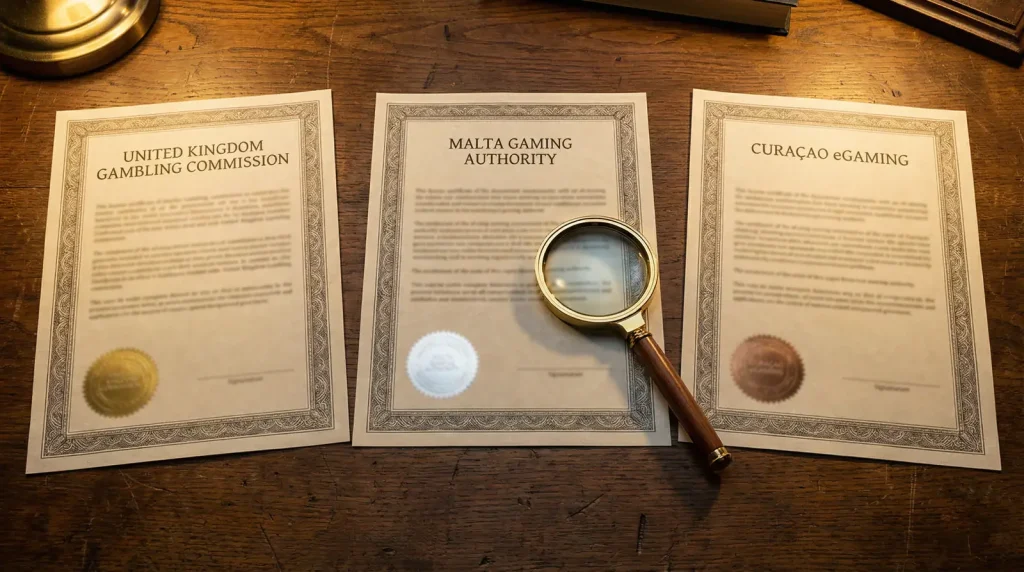
Not All Gambling Licences Offer the Same Protection
A Curaçao licence and a UKGC licence are both “licences” — but the gap in player protection is enormous.
The word “licensed” appears on the homepage of virtually every online casino, regardless of where that licence was issued or what it actually requires. A casino licensed by the UK Gambling Commission operates under some of the world’s strictest gambling regulations — covering fund protection, dispute resolution, responsible gambling tools, advertising standards, and ongoing compliance monitoring. A casino licensed by the Curaçao Gaming Control Board operates under a framework that imposes a fraction of those requirements. Both casinos can truthfully describe themselves as “licensed.” The difference in what that licence means for you as a player is not a matter of degree. It is a matter of kind.
Understanding the three most commonly encountered licensing jurisdictions — the UK, Malta, and Curaçao — gives you a practical framework for assessing the safety of any online casino you encounter. The UKGC is the reference standard for UK players. The Malta Gaming Authority is a credible alternative that many international operators hold alongside or instead of a UKGC licence. Curaçao is the jurisdiction that raises the most questions and provides the fewest answers when something goes wrong.
The comparison is not about ranking countries. It is about understanding what each regulatory framework requires of operators and what protections each framework provides to players. If you gamble at a casino licensed only in Curaçao, you are operating outside the UK’s regulatory safety net. That is a decision you are free to make, but it should be an informed one.
UKGC: The Gold Standard for Player Safety
The UKGC imposes the strictest requirements on fund protection, dispute resolution, and responsible gambling.
The UK Gambling Commission regulates under the Gambling Act 2005 and enforces licence conditions that are among the most detailed and demanding in any regulated gambling market. Operators must segregate or protect player funds under a three-tier system, provide access to an approved Alternative Dispute Resolution provider, implement responsible gambling tools including deposit limits and self-exclusion integration through GAMSTOP, comply with strict advertising standards, and submit to ongoing compliance monitoring that includes unannounced inspections and mandatory reporting of key events.
The enforcement record is substantial. The Commission publishes details of every regulatory settlement, fine, and licence action it takes, creating a public record that holds operators accountable. Penalties in recent years have run into the tens of millions of pounds for individual operators, with breaches related to anti-money laundering, social responsibility failures, and underage access attracting the most severe sanctions. This enforcement visibility acts as a deterrent and provides players with evidence of active regulatory oversight.
For UK players, the UKGC licence carries practical protections that no other jurisdiction matches. If a dispute arises, you have access to a free ADR process with a binding outcome for the operator. If an operator becomes insolvent, the fund protection requirements determine the security of your balance. If you need to self-exclude, GAMSTOP covers every UKGC-licensed site simultaneously. If the operator fails to meet its obligations, the Commission has the power to fine, suspend, or revoke the licence — and has demonstrably exercised all three.
The limitation of the UKGC licence is scope. It only covers operators licensed to serve the UK market. A casino with a UKGC licence is regulated for its UK operations; its operations in other markets are governed by whatever licences it holds in those jurisdictions. For a UK player, however, the UKGC licence is the one that matters, because it is the one that provides enforceable rights under UK law.
Malta Gaming Authority: Strong But Different
The MGA is respected and rigorous — but its complaint procedures and enforcement differ from the UKGC’s.
The Malta Gaming Authority is one of the most established gambling regulators in Europe, licensing a large proportion of the online casinos that serve EU markets. Its regulatory framework covers many of the same areas as the UKGC’s: operator fitness and probity, player fund protection, game fairness testing, responsible gambling obligations, and anti-money laundering compliance. Many operators hold both an MGA and a UKGC licence, using the MGA licence for their European operations and the UKGC licence for their UK-facing business.
Where the MGA differs from the UKGC is in the specifics of enforcement and player recourse. The MGA’s complaints process routes through the Authority itself rather than through independent ADR providers. Players can submit complaints to the MGA’s Player Support Unit, which mediates between the player and the operator. The process is functional but less formalised than the UK’s tiered system of internal complaints, independent ADR, and regulatory oversight. Resolution timescales can be longer, and the outcomes are less transparent — the MGA does not publish individual case decisions in the way that UK ADR providers do.
Fund protection under the MGA requires operators to hold player funds in a separate account from operational funds — equivalent to medium protection under the UKGC framework. The MGA does not offer the three-tier system that the UKGC uses, but its single standard is higher than Curaçao’s. Responsible gambling tools — deposit limits, session limits, and self-exclusion — are required under MGA licence conditions, though the implementation varies between operators and there is no equivalent to GAMSTOP’s universal cross-platform self-exclusion.
For a UK player, an MGA licence on its own is not a substitute for a UKGC licence. If you gamble at a casino licensed only by the MGA, your dispute rights and regulatory protections are governed by Maltese law and MGA procedures, not UK law. The MGA is a credible regulator, and its licensees are generally well-run, but the practical protections for UK players are materially different from those available under a UKGC licence.
Curaçao: Popular Among Operators, Less Protective for Players
Curaçao’s lower compliance costs attract operators — but its enforcement and player recourse are limited.
Curaçao has been a gambling licensing jurisdiction since 1996, and it hosts a large number of online casino operators. The appeal for operators is primarily commercial: the licensing process is faster, the compliance requirements are lighter, and the ongoing regulatory burden is significantly less demanding than the UKGC or MGA frameworks. For a company that wants to launch an online casino quickly and at low cost, Curaçao offers the path of least resistance.
For players, the picture is different. Curaçao’s regulatory framework does not require fund segregation at the levels mandated by the UKGC or MGA. Responsible gambling tools — deposit limits, session limits, self-exclusion — are not uniformly required or enforced. The complaint process is limited: Curaçao does not operate an independent dispute resolution service comparable to the UK’s ADR system or the MGA’s Player Support Unit. If you have a dispute with a Curaçao-licensed casino, your options are largely limited to the operator’s own internal complaint process and, beyond that, civil legal action in Curaçao’s courts — a practically unrealistic route for most UK players.
Enforcement is the most significant gap. The Curaçao Gaming Control Board has historically taken limited public enforcement action against licensed operators. Fines, licence revocations, and published enforcement decisions are rare compared to the UKGC’s frequent and detailed public actions. For players, this means the deterrent effect that keeps operators in line is weaker. An operator that withholds a withdrawal or changes its terms unfavourably faces less regulatory risk in Curaçao than it would under the UKGC.
It is also worth noting that a Curaçao licence does not authorise a casino to legally offer gambling to UK residents. Under the Gambling Act 2005, any operator offering gambling to consumers in Great Britain must hold a UKGC licence. A casino operating under a Curaçao licence that accepts UK players without a UKGC licence is operating illegally in this jurisdiction. Players at such sites have no access to the UK regulatory framework and no recourse through the Gambling Commission.
Licence Jurisdiction Is a Safety Decision
When choosing a casino, the licence isn’t a detail — it’s the first thing to check.
The licence a casino holds determines the rules it must follow, the protections you receive, and the options available to you if something goes wrong. A UKGC licence provides the strongest framework: enforceable dispute resolution, fund protection tiers, mandatory responsible gambling tools, and active regulatory enforcement. An MGA licence provides a credible alternative with meaningful protections, though the practical recourse for UK players is less direct. A Curaçao licence provides minimal player protections and no legal basis for serving UK customers without a UKGC licence alongside it.
The check takes seconds. Look at the casino’s footer for its licence details, click through to the regulator’s register, and confirm the licence is valid. If the casino holds a UKGC licence, you are within the UK’s regulatory framework. If it holds only an MGA licence, you are within Malta’s. If it holds only a Curaçao licence and is actively marketing to UK players, you are dealing with an operator that is not legally compliant in this country — and every protection that should stand between you and a bad outcome is absent. The licence is not fine print. It is the foundation that everything else rests on.
Comparing UKGC, MGA and Curaçao Licences — More on this topic at safeonlinecasino-uk.
See also Articles.