
Casino KYC Verification: Documents, Process and Timelines
Best Non GamStop Casino UK 2026
Loading...
KYC Isn’t Bureaucracy — It’s a Legal Requirement
Every UK casino must verify your identity. It’s not optional, and it protects you as much as it protects them.
Know Your Customer — KYC — is the process through which UKGC-licensed casinos confirm that you are who you claim to be, that you are old enough to gamble, and that you are not using the platform for money laundering. These are not discretionary checks. The UK Gambling Commission’s Licence Conditions and Codes of Practice require every remote operator to verify the identity and age of customers before allowing them to gamble or, at the latest, before allowing a withdrawal. The Money Laundering, Terrorist Financing and Transfer of Funds Regulations 2017 impose additional obligations that overlap with and reinforce the UKGC’s requirements.
From the player’s perspective, KYC can feel like an obstacle — particularly when you have just won and want to withdraw. The request for documents arrives at the moment when patience is lowest and suspicion is highest. But the process exists because without it, casinos would have no reliable way to prevent minors from gambling, no mechanism to detect fraudulent identities, and no defence against accounts being used to launder the proceeds of crime. Every legitimate operator runs these checks because the alternative is losing their licence.
The scope of KYC has expanded in recent years. Under financial vulnerability rules introduced from February 2026, casinos must also conduct enhanced due diligence when a customer’s net deposits reach certain thresholds — particularly the £150 trigger for financial vulnerability screening. This means KYC is no longer a one-time check at registration. It is an ongoing process that can request additional documentation at any point during your time as a customer, and understanding how it works saves time, frustration, and the nagging feeling that the casino is stalling.
What Documents You’ll Need and When
Passport or driving licence, proof of address, and sometimes source of funds.
The standard KYC document set at a UK online casino consists of three categories: proof of identity, proof of address, and — in certain circumstances — proof of source of funds. The first two are requested from virtually every player. The third is triggered by specific thresholds or risk indicators.
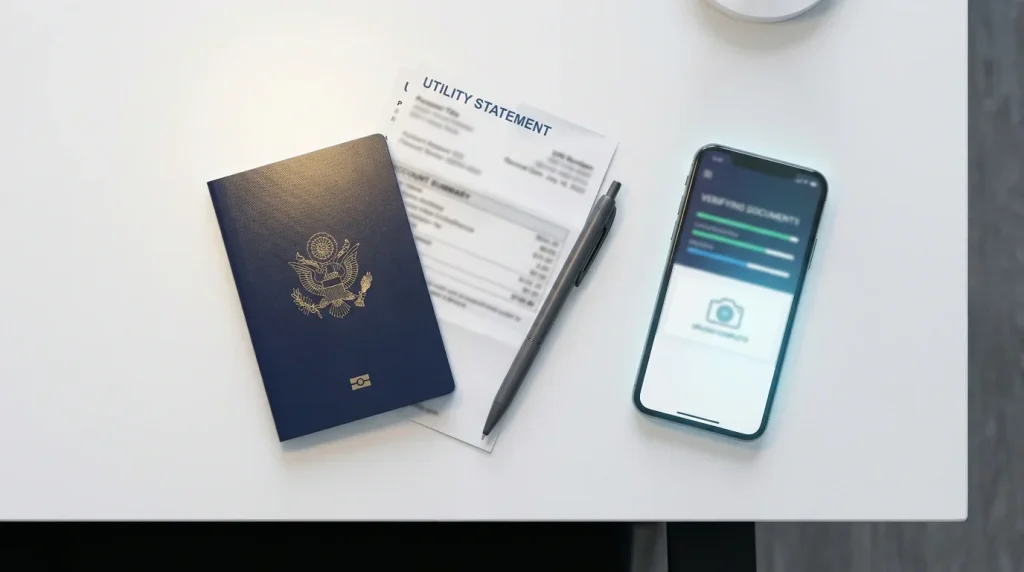
Proof of identity means a government-issued photographic document. A UK passport or UK driving licence is accepted by every UKGC-licensed casino. Some operators also accept EU or international passports and national identity cards, though acceptance varies. The document must be current — expired documents are rejected. The casino needs to see the photo page clearly, with all text legible and no areas obscured. For passports, this means the double-page spread showing your photo, name, date of birth, and passport number. For driving licences, both sides are typically required.
Proof of address requires a recent document — usually dated within the last three months — showing your name and residential address. Accepted documents typically include a bank statement, utility bill, council tax bill, or a letter from HMRC. Mobile phone bills are sometimes accepted but not universally. The document must be an official statement, not a printout of an app screen or an edited PDF. Some casinos now accept electronic statements downloaded directly from your bank’s website, provided the formatting clearly shows it is an official document.
Source of funds documentation is requested when a casino’s internal risk assessment flags a need. This can be triggered by large deposits, rapid increases in spending, or when net deposits exceed the £150 affordability threshold. Source of funds evidence might include recent payslips, a bank statement showing salary deposits, documentation of a property sale, or evidence of savings. The purpose is to confirm that the money being gambled comes from a legitimate, identifiable source. These requests are less common than basic identity and address checks, but they are becoming more frequent as regulatory expectations around affordability monitoring tighten.
Timing varies by operator. Some casinos require identity verification before your first deposit. Others allow deposits and play but require verification before your first withdrawal. A third group verifies in stages: basic electronic checks at registration, with document requests triggered later by withdrawal amounts or spending patterns. Knowing which approach your chosen casino uses — usually stated in the terms of service — lets you prepare documentation in advance rather than scrambling when a withdrawal is pending.
How to Speed Up the Verification Process
Submit documents before you request your first withdrawal — and keep names consistent.
The single most effective way to accelerate KYC is to complete it before you need it. Most casinos provide an account verification section in your profile settings where you can upload documents at any time. Doing this within the first day of registration means that by the time you request a withdrawal, your identity and address have already been confirmed. The withdrawal processes without additional delay, and you avoid the frustration of watching a pending cashout while waiting for a document review.
Document quality matters more than players typically realise. A blurry photograph, a partially cropped driving licence, or a utility bill where the date is cut off will be rejected and require resubmission. Use good lighting, photograph the entire document against a plain background, and ensure every corner is visible. If you are uploading a bank statement as proof of address, make sure it includes your full name, address, the bank’s name, and a date within the last three months — all on the same page.
Name consistency is a common stumbling block. If your casino account is registered as “James Smith” but your passport reads “James Robert Smith” and your utility bill shows “J. Smith,” the verification team may request clarification or additional documents. Register with the exact name shown on your primary identity document, and ensure your proof of address uses the same format where possible. Minor variations are usually resolved quickly, but matching details from the start eliminates the delay entirely.
If a casino requests source-of-funds documentation, respond promptly and provide exactly what they ask for. A payslip from the current or preceding month is the most straightforward evidence for salaried employees. For self-employed players, a recent tax return or accountant’s letter serves the same purpose. Delay in providing these documents delays your withdrawal — and the casino cannot legally process it until its compliance team is satisfied.
What Happens If Verification Fails
A failed check doesn’t mean you’ve done something wrong — mismatched details are the usual cause.
Most KYC failures are not the result of fraud or deliberate misrepresentation. They stem from mundane issues: a document was too blurry to read, the address on the proof of residence didn’t match the address on file, a name was entered differently across documents, or an expired passport was submitted by mistake. In these cases, the casino’s verification team will contact you — typically by email — explaining what failed and what they need to resolve it. The fix is usually straightforward: resubmit a clearer image, provide an alternative document, or update the details on your account to match your ID.
If electronic verification fails at the registration stage — where the casino checks your name, date of birth, and address against databases like the electoral roll — you may be asked to provide physical documents earlier than other players. This does not indicate a problem with your application. It means the automated check could not find a confident match, which can happen if you recently moved, if your name has changed, or if your address is not on the electoral register. Providing a passport and a recent utility bill typically resolves the issue within 24 to 72 hours.
In rare cases, a casino may close an account where verification cannot be completed. This usually happens when a player fails to respond to document requests within the timeframe specified in the terms — often 30 days. Any remaining balance is returned via the original deposit method. The closure is an administrative action, not an accusation, and it does not prevent you from registering at another casino where you can complete verification successfully.
The Paperwork That Unlocks Everything Else
Complete KYC once, properly, and every future withdrawal is smoother.
KYC verification is one of those tasks that feels tedious until it is done, and invisible once it is. The first withdrawal at any new casino is the one where KYC typically bites — the delay, the document requests, the waiting for a compliance officer to review your passport photo. Every withdrawal after that, assuming your details remain unchanged, processes without the same friction. The verification is already on file, the checks have been passed, and the casino’s system flags your account as verified.
The players who have the smoothest experience are the ones who treat KYC as part of registration rather than an afterthought. The small preparations — consistent naming, clear document scans, proactive uploads — convert a potential multi-day delay into a non-event. It is not glamorous work, but it is the gate through which every pound of winnings must pass, and walking through it early is better than discovering it later with money on the line.