Casino Game Volatility: Low, Medium and High Explained
 Available in GB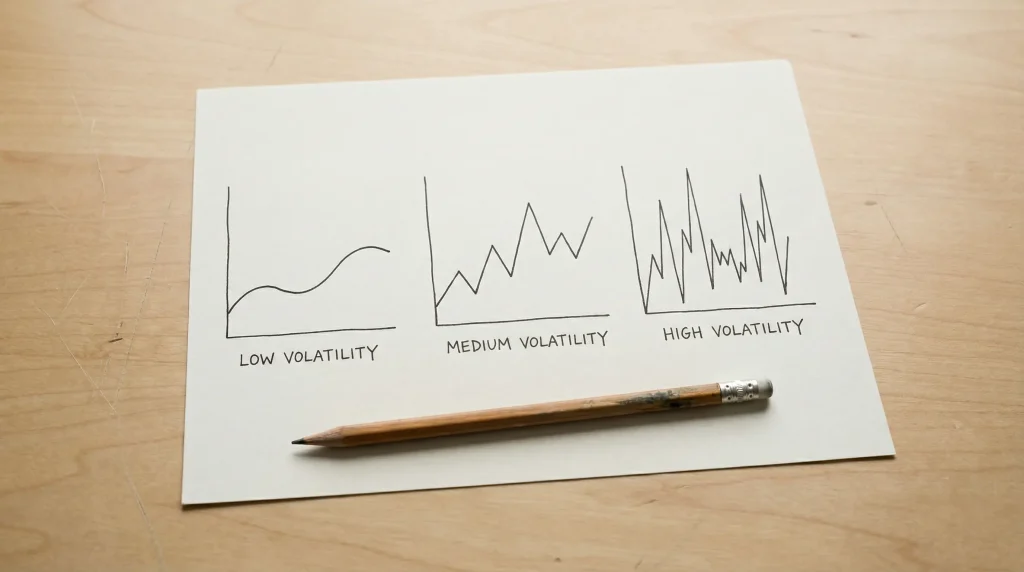
Volatility Tells You How a Game Feels — RTP Tells You What It Returns
Two games can share 96% RTP and feel completely different to play.
Return to Player and volatility are the two numbers that define the character of a casino game, and they describe entirely different things. RTP tells you the theoretical percentage of wagered money that a game returns to players over an infinite number of spins or rounds. A 96% RTP means that, across millions of plays, the game is designed to return 96p for every £1 wagered. It is a long-term statistical average, not a description of any individual session.
Volatility — also called variance — tells you how that return is distributed. A low-volatility game pays out frequently in small amounts, creating a relatively steady session where your balance fluctuates gently around its starting point. A high-volatility game pays out rarely but in larger amounts, creating sessions characterised by extended losing streaks interrupted by significant wins. Both games can have an identical RTP. The experience of playing them is profoundly different.
This distinction matters because most players choose games based on theme, graphics, or brand recognition without considering volatility. A player with a £20 budget who selects a high-volatility slot expecting frequent entertainment may burn through that budget in minutes without hitting a meaningful win. The same player on a low-volatility game might play for an hour with the same starting balance. Neither outcome changes the RTP — the maths is identical — but the session experience, the entertainment value, and the rate at which money is consumed are all determined by volatility.
Understanding both numbers together gives you a more honest picture of what a game will actually feel like to play, rather than what it theoretically returns over infinity.
Low, Medium and High Volatility: What to Expect
Low: steady drip of small wins. Medium: balanced sessions. High: long dry spells punctuated by large payouts.
Low-volatility games are designed around frequency. Wins are small relative to the stake but they arrive regularly — often every few spins on a slot or every few hands in a card game. The typical session on a low-volatility slot sees your balance hover within a narrow range of its starting point. You might finish a 200-spin session with 90% of your deposit still intact, having experienced a steady rhythm of small returns that keep the session alive. The excitement comes from consistency rather than spikes, and the format suits players who want their bankroll to last as long as possible.
Medium-volatility games occupy the middle ground. Wins are less frequent than on low-volatility titles but larger when they arrive. A typical session involves noticeable dips in your balance followed by recoveries when a medium-sized win lands. The rhythm is less predictable than low volatility but more forgiving than high. Most mainstream UK slot titles — the ones that dominate the lobbies of major operators — fall into the medium-volatility category. They are designed to provide a balance of tension and reward that appeals to the broadest range of players.
High-volatility games are built for patience and risk tolerance. Wins are infrequent, and the gaps between them can be long enough to drain a modest bankroll entirely. When a win does arrive, it tends to be large — sometimes hundreds of times the stake, particularly if a bonus feature triggers. The appeal is the potential for a life-changing payout from a single spin, and this is the format that attracts players drawn to the jackpot narrative. The reality, however, is that most sessions on a high-volatility game end in loss. The large wins that define the category are statistically rare, and the extended dry spells between them are the price of chasing that potential.
None of these categories is inherently better or worse. They serve different player profiles, different bankroll sizes, and different definitions of entertainment. The mistake is choosing a volatility level that does not match your budget or expectations and then blaming the game for delivering exactly what it was designed to deliver.
How Volatility Affects Your Bankroll and Session Length
On a high-volatility slot, your bankroll can vanish in 30 spins. On a low-volatility one, it lasts.
Bankroll management and volatility are directly linked, and ignoring the relationship is one of the most common mistakes casual players make. A useful way to think about it: your bankroll needs to be large enough to survive the dry spells that the game’s volatility will produce. On a low-volatility slot at £0.20 per spin, a £20 bankroll gives you roughly 100 spins — enough for the frequent small wins to keep your balance alive for a meaningful session. On a high-volatility slot at the same stake, those 100 spins might yield no significant wins at all, and your £20 is gone before the game’s payout mechanics have had a chance to activate.
The maths is not complicated but it is routinely ignored. High-volatility games are designed for bankrolls that can absorb 200 to 500 losing spins without running dry. If your budget for a session is £20, that rules out high-volatility slots at anything above the minimum stake — and even at minimum stake, the experience will feel punishing more often than rewarding. Low and medium volatility are designed for exactly this scenario: smaller budgets, longer sessions, and a payout distribution that returns enough frequently enough to sustain play.
Session length follows directly from bankroll survival. A player who chooses a volatility level appropriate to their budget will have longer, more enjoyable sessions. A player who reaches for high volatility on a thin budget will have short, frustrating sessions dominated by watching their balance decline. The volatility rating told you this would happen. The question is whether you checked it before pressing play.
Where to Find Volatility Ratings
UK-licensed games now display volatility in the information panel alongside RTP.
Since the UKGC tightened transparency requirements, games offered at UK-licensed casinos must display key information including RTP and, increasingly, a volatility indicator. This information is typically found in the game’s information panel or help section — accessible via an “i” icon or a menu button within the game interface. The volatility is usually expressed on a simple scale: low, medium, medium-high, or high. Some providers use a numerical scale from 1 to 5 or a descriptive label such as “high variance.”
Game providers are the primary source of volatility data. Pragmatic Play, for example, labels every slot with a volatility rating in its game information. NetEnt and Red Tiger follow similar practices. Evolution’s live games do not carry volatility ratings in the same format, but the nature of live table games — blackjack, roulette, baccarat — follows well-established mathematical volatility profiles that do not vary between providers.
Third-party review sites also publish volatility ratings, though these are sometimes estimated rather than confirmed by the provider. If you want a definitive answer, check the game’s own information panel first. If the rating is not displayed there, the provider’s website or the casino’s game catalogue may list it. The information exists. Finding it requires a few clicks rather than a search engine query, but the effort is minimal relative to the value of knowing what a game is designed to do with your money.
Pick the Volatility That Matches Your Budget, Not Your Ambition
High volatility is designed for bigger bankrolls. Playing it on a small budget is a fast way to zero.
The allure of high-volatility games is understandable. The screenshots of 5,000x wins, the YouTube compilations of bonus round jackpots, the marketing that frames every spin as a potential life-changer — all of it points toward the high end of the volatility spectrum. What the marketing omits is the denominator: the hundreds of thousands of spins that produced nothing, from players who funded the maths that made the headline win possible.
Choosing a game’s volatility should be a budgeting decision, not an aspirational one. If you have set a session budget of £30, low or medium volatility will give you the most play, the most entertainment, and the highest probability of finishing the session with something left. If your bankroll is deeper and you understand that most sessions will end in loss, high volatility offers the possibility of outsized returns — with the explicit trade-off that the journey to those returns is expensive and unpredictable.
Volatility is not a measure of quality. A low-volatility slot is not a worse game than a high-volatility one. It is a different game, designed for a different experience and a different financial reality. The best choice is the one that aligns your budget with the experience the game is built to deliver. Everything else is marketing.
Casino Game Volatility — More on this topic at safeonlinecasino-uk.
See also UK Stake Limits 2026.