
What Is RTP and How Does It Affect Your Winnings?
 Available in GB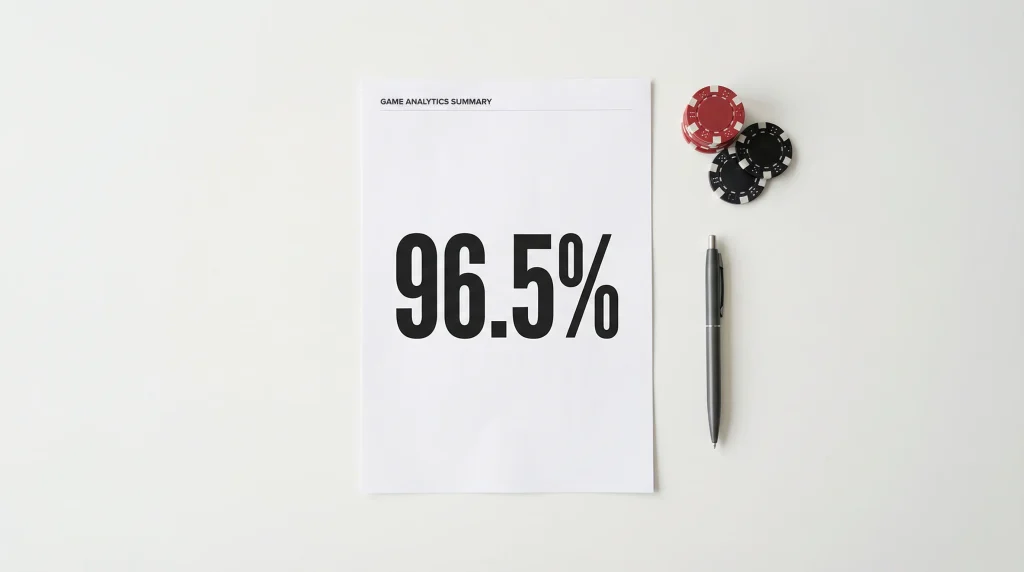
RTP Is the Single Most Useful Number on Any Casino Game
Return to Player tells you what percentage of wagered money a game pays back over time — and most players never check it. That’s a problem, because RTP is the one number that gives you a genuine, mathematically grounded expectation of how a game behaves. Not a marketing claim, not a reviewer’s opinion, not a “feeling” about whether a slot is generous. A statistic, derived from millions of simulated rounds and verified by independent testing laboratories.
Here’s what the number actually represents. If a game has an RTP of 96%, it means that for every £100 wagered across all players over an extended period, the game is expected to return £96. The remaining £4 is the house edge — the casino’s mathematical margin. That 96% doesn’t mean you personally will get £96 back from your next £100 session. It means the game, across its entire lifetime of play, trends toward that return rate. The distinction between the long-term statistical average and your individual session outcome is the most important thing to understand about RTP, and it’s where most confusion begins.
RTP matters because it lets you compare games on an equal footing. Two slots might look identical in terms of theme, graphics, and bonus features, but if one has an RTP of 97.3% and the other sits at 94.1%, the mathematical experience over time is meaningfully different. Over a thousand spins at £1 each, the first game statistically retains £27 while the second keeps £59. That’s not a rounding error. It’s the difference between a game that nibbles at your bankroll and one that chews through it.
At UKGC-licensed casinos, RTP is not a voluntary disclosure. Since regulatory changes that took effect in 2026, every game available to UK players must display its RTP in the game information panel. This was a deliberate move by the Gambling Commission to shift transparency from something operators could boast about selectively to something players could demand consistently. The information was always technically available — now it’s required to be visible.
How RTP Is Calculated and Tested
RTP is a statistical average across millions of spins — not a promise about your next session. Understanding how the number is produced helps explain both its reliability and its limitations.
Game developers build the RTP into a game’s mathematical model during the design phase. Every element — base game hit frequency, bonus trigger probability, multiplier distribution, free spin mechanics — feeds into a formula that determines the theoretical return. Before the game goes live, independent testing laboratories run simulations. These are not casual test runs. Firms like eCOGRA, iTech Labs, and GLI process tens of millions, sometimes hundreds of millions, of rounds through the game engine to verify that the actual return matches the theoretical model within an acceptable margin of variance.
The testing process also checks for randomness in the underlying random number generator. Each outcome must be statistically independent of every other outcome. If the RNG shows any pattern — clustering, predictability, deviation from expected distribution — the game fails certification. The RTP figure and the RNG integrity are tested together because one without the other is meaningless. A game could return 96% on average but do so through manipulated sequencing, which would compromise fairness even if the headline number looked right.
Once a game is deployed, operators are required to maintain the certified RTP settings. Some games offer operators a choice of RTP configurations — a developer might release a slot with settings at 96.5%, 94.5%, and 92.2%. The operator selects a setting, and that setting must be disclosed to players and match the certified configuration. This is where vigilance matters: the same game title can run at different RTPs depending on the casino. Checking the information panel inside the game itself, rather than relying on a generic review, is the only way to confirm the specific RTP applied at that particular site.
Auditing doesn’t stop at launch. Licensed operators submit to periodic compliance reviews, and testing labs conduct ongoing monitoring for high-traffic titles. The system isn’t flawless — no regulatory framework is — but it creates multiple verification layers between the game’s mathematical model and the player’s experience.
Where to Find RTP Information at UK Casinos
Under rules introduced by the Gambling Commission, every UK-licensed game must now display its RTP in the game information panel. Before this requirement, finding the number could feel like a minor archaeological expedition — buried in help files, hidden behind sub-menus, or available only on the game developer’s website. The regulatory change made the information mandatory and accessible within the game interface itself.
In practice, you’ll find the RTP by opening the game and looking for an information icon, usually represented by a small “i” or a question mark symbol. Clicking it opens a panel that displays the game rules, paytable, and — critically — the Return to Player percentage. Some games display it prominently at the top of the information screen. Others place it further down, after the paytable and bonus rules. Either way, it must be there.
A useful habit is to check the RTP before your first spin on any new game. Not because a difference of half a percentage point will transform your session, but because the practice keeps you focused on the mathematical reality of what you’re playing rather than the visual excitement. A game with flashy animations and an immersive soundtrack might feel generous. The RTP panel tells you whether that feeling has any statistical basis.
For players who want to compare RTPs across many titles before choosing what to play, several game developers publish full RTP tables on their corporate websites. This can save time if you’re evaluating a large library. However, always confirm the figure inside the game at the specific casino you’re using, because the operator may have selected a different RTP configuration from the one listed on the developer’s general reference page.
RTP vs Volatility: Two Numbers, Two Different Stories
A 96% RTP on a high-volatility slot feels nothing like 96% on a low-volatility one. That’s the core of the distinction, and it trips up players who treat RTP as the only metric that matters.
RTP tells you the long-term return. Volatility tells you how that return is distributed across individual sessions. A low-volatility slot pays out frequently in small amounts. Your balance drifts downward gradually, punctuated by regular small wins that extend your playing time. A high-volatility slot pays less often but in larger amounts. Your balance can drop sharply for extended stretches — dozens of spins with minimal returns — before a bonus round or a large hit recovers a significant portion. Both games might share the same 96% RTP, but the experience of playing them is entirely different.
Think of it this way: RTP is the destination, volatility is the road. Two routes can lead to the same average outcome while offering very different journeys. On the low-volatility road, the scenery changes steadily and predictably. On the high-volatility road, there are long stretches of nothing followed by sudden, dramatic views. Neither route is objectively better — but one might suit your bankroll, your temperament, and your session length far better than the other.
The practical implication is straightforward. If you have a modest bankroll and want your session to last, low-volatility games are mathematically kinder to your balance. If you have a larger budget and you’re playing specifically for the chance of a significant win, high volatility is where that opportunity lives — along with the elevated risk of hitting zero faster. Ignoring volatility while fixating on RTP is like choosing a car based solely on fuel efficiency without asking how it handles the motorway.
UK-licensed games now display volatility ratings alongside RTP in the game information panel, though the labelling varies. Some use a simple low/medium/high scale. Others use numerical ratings or descriptive terms. The format differs, but the underlying information is the same: how bumpy is the ride going to be?
Thinking in Percentages, Not Promises
RTP doesn’t predict your session — it describes the game’s behaviour across infinity. And that’s precisely why it’s valuable.
The temptation when looking at a 96% RTP is to think “I’ll get most of my money back.” That’s not wrong as a general sentiment, but it misrepresents how individual sessions actually work. In any given sitting, you might finish up 40%, down 60%, or anywhere in between. The 96% only materialises as an average when you zoom out far enough — across thousands of players and millions of rounds. Your personal experience will be one data point in that average, not the average itself.
This doesn’t make RTP useless. Quite the opposite. It means you should use it as a tool for selection, not prediction. When choosing between two games you find equally entertaining, the one with the higher RTP gives you a better expected return over time. When deciding whether a game’s house edge is acceptable relative to your budget, the RTP tells you exactly what that edge is. When evaluating whether a casino’s game library favours players or the operator’s margins, comparing RTP ranges across the portfolio gives you a factual basis for judgement.
The shift toward mandatory RTP disclosure at UK casinos was designed to make this kind of thinking easier. Before it was required, RTP was specialist knowledge — something enthusiasts discussed on forums while casual players remained unaware. Now it’s displayed in every game. The information is there. The only question is whether you look at it.
Percentages don’t make gambling safe. Nothing does — there is always a mathematical cost to playing, and the house edge ensures that cost is built into every game. But percentages make gambling transparent, and transparency is the foundation on which every other safety measure is built.
What Is RTP and How Does It Affect Your Winnings? — More on this topic at safeonlinecasino-uk.
See also House Edge Explained.